A Gathering on Memory, Archives and the Reparative
AFTERIMAGE
A Gathering on Memory, Archives and the Reparative
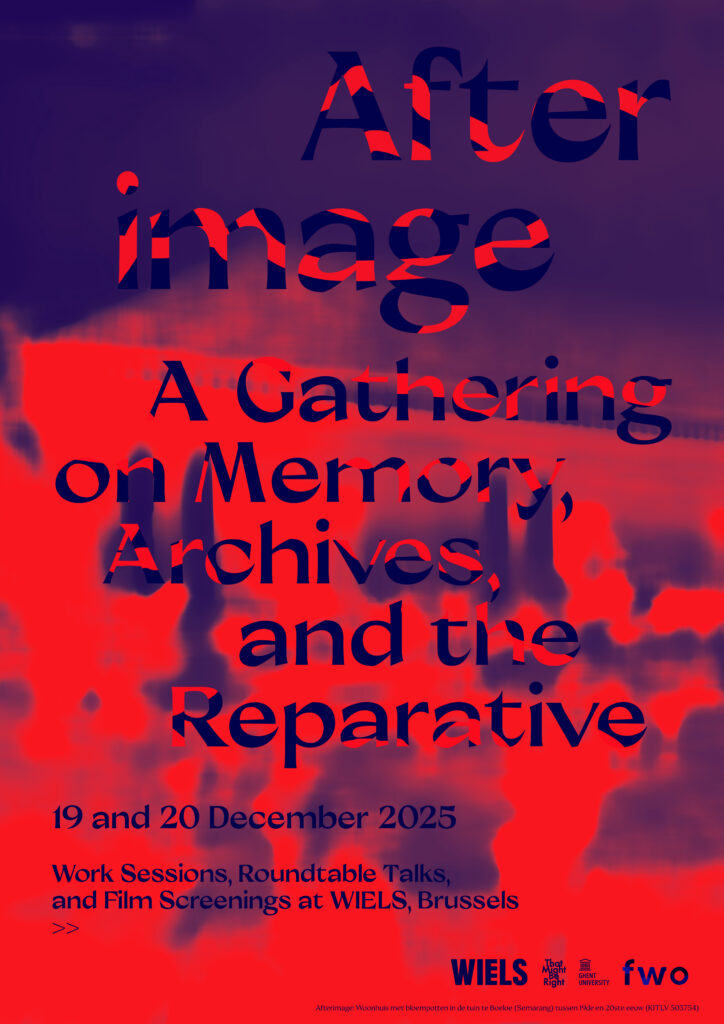
AFTERIMAGE is a two-day public gathering on memory, archives, and reparative practices, which explores through work sessions, roundtable talks, and film screenings how we might perceive differently what appears within the archive. What modes of attention, sensitivity, and collective reading can open new perspectives? How can varied approaches to memory and the archive resonate with one another, and how might gestures of repair emerge through collective thinking and doing?
PROGRAMME
DAY I — 19 December 2025
13:30 Welcome @WIELS
14:00 – 15:30 Work session I: Tracing the Archive
Angga Cipta and Paoletta Holst
Work session around archival tracing and copy techniques.
In the past, architects have employed a range of techniques—such as tracing paper, blueprints, and photography—to replicate their designs for distribution and the sharing of their ideas. In this workshop, however, we will use the act of tracing and copying as a critique to move beyond mere replication and ask how such techniques played a role in shaping colonial domestic cultures and the facilitation and spread of colonial systems of extraction, hierarchy, and control within architecture and spatial practices.
Limited places available, register for Work session I via mail@paolettaholst.info
16:00 – 17:00 Introduction: AFTERIMAGE
Paoletta Holst and Túlio Rosa
Tracing the questions and concerns that arose during the work sessions they had been organizing at WIELS, Paoletta and Túlio will introduce the gathering by reflecting on how their research trajectories intersect around archival engagement, composition, and reparative gestures. Revisiting the shared processes and conversations developed in these sessions, they will outline the path toward this public moment and open the ground for the discussions to come.
17:00 – 18:30 Roundtable talk
Panel: Otty Widasari, Setareh Noorani and Paoletta Holst
Moderation: Túlio Rosa
Departing from the urgencies and challenges involved in collecting or activating archival materials in different parts of the world—such as Indonesia and the Netherlands—the conversation reflects on methodologies for collective interpretation and creation within both institutional and localized archival practices. Recognizing that discussions on archives and colonial histories are shaped by their specific contexts, and that motivations for engaging with the past stem from distinct present-day needs, it considers how shifting attention from institutional claims to more situated forms of memory can foster multiple perspectives and enable dialogue across these differing discussions.
18:30 Break and move to GC Ten Weyngaert
19:00 Welcome @GC Ten Weyngaert
Gemeenschapscentrum Ten Weyngaert, Rue des Alliés 54, 1190 Forest
19:30 – 21:30 Screenings
Curation: Forum Lenteng
22:00 End
________
DAY II — 20 December 2025
13:30 Welcome @WIELS
14:00 – 15:30 Work session II: Engaging Lesbian Information Activist Pasts
Emma Ydiers
This work session examines scattered archival traces of lesbian information activism in Belgium around 1985. Magazines produced or collected within these activist circles are taken out of institutional archives, are brought back into dialogue with each other, and are engaged within a new time and space, where different interpretive codes apply. By repeatedly exploring these materials in relation to one another and the self, participants experiment with ways of historicizing, connecting, and narrating lesbian pasts from the present. The work session continues a tradition in which reading, researching, writing, assembling, communicating, and archiving functioned as tactics for creating counterpublics. Materials extracts from Artemys, Les Lesbianaires, the Lesbian Herstory Archives, and Vrouwenwoorden/De Paarse Paperpot/De Paperpot.
Limited places available, register for Work session II via mail@paolettaholst.info
16:00 – 17:00 Intervention/Reading: What if?
Simon Asencio and Túlio Rosa
What if? emerges from an exchange between Simon Asencio and Túlio Rosa around the script as a research device and a framework for collective authorship. Bringing together distinct yet resonant practices, they use scripting to mobilize complex materials, activate multiple voices, and reframe archival or historical questions. The presentation takes the form of a public scripted reading, offering the audience an entry into their ongoing dialogue and treating the script not as a finished work but as a provisional space for study, composition, and collective thinking.
17:00 – 18:30 Roundtable talk
Panel: Emma Ydiers, Simon Asencio and Túlio Rosa
Moderation: Paoletta Holst
Reflecting on approaches to the archive that unfold through reading, staging, rewriting, and collective composition, the conversation considers how positionality and the role of the reader shape the ways we approach and reframe archival materials. Foregrounding the situated nature of inquiry, it examines how artistic practices engage archives through methods that embrace relationality and uncertainty, and how proximity, friction, and fabulation open possibilities for research, allowing us to consider how composition itself may begin to operate as a reparative gesture.
18:30 Break and move to GC Ten Weyngaert
19:00 Welcome @GC Ten Weyngaert
Gemeenschapscentrum Ten Weyngaert, Rue des Alliés 54, 1190 Forest
19:30 – 21:30 Screenings
Curation: Sandra Benites
22:00 End

